Evaluating Spring in the Woods Watercolor Animals for Creative Projects
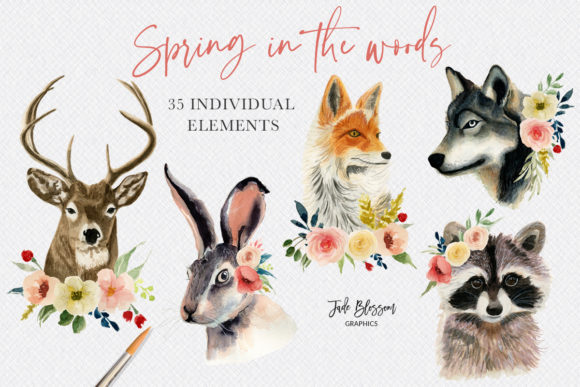
Selecting digital assets requires a careful assessment of technical specifications, aesthetic alignment, and practical utility. The Spring in the Woods - Watercolor Animals collection presents a specific set of resources designed for creators focusing on nature-inspired themes. This asset pack includes 35 individual elements, featuring five distinct floral animals, all provided as separate PNG files with transparent backgrounds. Understanding the capabilities and limitations of this collection is essential for designers, crafters, and small business owners determining if it aligns with their current project requirements.
Defining the Asset Collection
The Spring in the Woods - Watercolor Animals package is a curated digital download centered on soft, organic illustration styles. Unlike vector-based graphics that rely on mathematical paths, these assets are rasterized watercolor paintings. The collection is anchored by five primary "floral animal" illustrations, where wildlife subjects are integrated with botanical elements. These are supplemented by 30 additional individual elements, which typically include isolated flowers, leaves, branches, and forest accents that complement the main characters.
Technically, each file is delivered at 300 DPI (dots per inch) with dimensions approximately 20 cm or 7.87 inches. The transparent background format ensures that these elements can be layered over various colored backdrops or textures without requiring manual masking. This specification positions the collection as a mid-to-high-resolution resource suitable for standard commercial printing and high-quality digital display, though it differs significantly from scalable vector formats used in large-format signage.
Primary Use Cases and Applications
Evaluators should consider how the specific aesthetic of Spring in the Woods - Watercolor Animals maps to intended outputs. The visual language of watercolor implies softness, nostalgia, and organic warmth, making it particularly effective for specific niches.
- Stationery and Paper Goods: The 300 DPI resolution at roughly 8 inches is optimal for greeting cards, wedding invitations, thank-you notes, and journal covers. The scale allows for full-page prints or multiple elements per page without pixelation.
- Product Decoration: For print-on-demand services, these elements work well on mugs, tote bags, and apparel. The transparent backgrounds facilitate easy placement on merchandise mockups. However, users must verify that the 7.87-inch size meets the minimum dimension requirements for larger products like blankets or shower curtains.
- Digital Branding and Web Design: Bloggers and social media managers utilize these assets for headers, Pinterest pins, and website accents. The watercolor style pairs effectively with serif typography and pastel color palettes common in lifestyle, wellness, and children’s education sectors.
- Event Styling: Party decorations, including cake toppers, favor tags, and banners, benefit from the cohesive theme. Having 35 separate elements allows for varied arrangements while maintaining a consistent visual identity across different event touchpoints.
Technical Benefits and Practical Advantages
The decision to acquire this collection often hinges on workflow efficiency and immediate usability. Several technical factors contribute to its practical value for non-illustrators and designers alike.
Instant Accessibility: As a digital download, the collection eliminates shipping wait times. This is critical for tight deadlines where physical art transfers are not feasible. Users can begin compositing immediately upon purchase.
Compositional Flexibility: Receiving 35 separate PNG files rather than a single flattened image offers significant creative control. Designers can adjust the spacing between floral animals and foliage, resize individual components independently, and create custom layouts that do not look identical to other users' work. This modularity is superior to pre-composed scenes for branding projects requiring unique variations.
Print-Ready Resolution: The 300 DPI standard ensures professional output for most handheld and desktop-sized items. At 7.87 inches, the files provide sufficient detail for close inspection, avoiding the blurriness associated with web-resolution clipart.
Limitations and Tradeoffs
An objective evaluation must also address scenarios where Spring in the Woods - Watercolor Animals may fall short. Recognizing these constraints prevents frustration during the production phase.
Raster vs. Vector Limitations: Because these are PNG files, they cannot be scaled up indefinitely without quality loss. While 7.87 inches is generous for stationery, it is insufficient for billboards, vehicle wraps, or large wall murals. Attempting to stretch these elements beyond 100% of their native size will result in visible pixelation and soft edges. Users requiring infinite scalability should seek SVG or EPS alternatives.
Aesthetic Specificity: Watercolor is a distinct stylistic choice. It does not pair well with corporate tech branding, industrial design, or minimalist geometric aesthetics. If the target audience expects sharp lines, flat colors, or modernist precision, this collection may communicate the wrong tone.
Color Editing Constraints: Unlike vector art where fill colors can be changed instantly, altering the hue of watercolor PNGs requires advanced photo editing skills. Adjusting saturation or shifting colors often degrades texture quality. Buyers should be satisfied with the original color palette as provided.
Decision-Making Framework for Buyers
To determine if this collection is the correct investment, evaluate your project against the following criteria.
When This Collection Is a Strong Fit
- Project Scale Matches Specs: Your final print size is within or below the 7.87-inch range per element.
- Theme Alignment: The project involves spring, nature, nursery, cottagecore, or feminine aesthetics.
- Need for Variety: You require a kit that provides both focal points (animals) and supporting elements (foliage) to build complete compositions.
- Workflow Preference: You prefer drag-and-drop layering in software like Canva, Photoshop, or Procreate over drawing from scratch.
When to Consider Alternatives
- Large Format Printing: If designing signage larger than A3/Tabloid, prioritize vector packs or ultra-high-resolution scans (600+ DPI).
- Brand Color Customization: If exact Pantone matching is required, commission custom vector art or use editable AI/EPS files.
- Non-Nature Themes: For urban, futuristic, or abstract projects, the organic watercolor style will likely clash with the intended message.
- Budget for Exclusivity: Digital downloads are typically non-exclusive. If brand differentiation is paramount and you cannot risk seeing similar artwork elsewhere, hiring an illustrator for bespoke work is necessary.
Final Considerations for Implementation
The Spring in the Woods - Watercolor Animals collection serves as a versatile foundation for specific creative applications. Its value lies in the balance between artistic quality and technical readiness for small-to-medium-scale projects. By understanding the 300 DPI constraint and the modular nature of the 35 elements, users can effectively leverage these assets for stationery, web design, and product decoration. Successful integration depends less on the assets themselves and more on matching their inherent characteristics—softness, fixed resolution, and natural themes—to appropriate design challenges. Careful evaluation of these factors ensures that the acquisition supports rather than hinders the creative objective.